
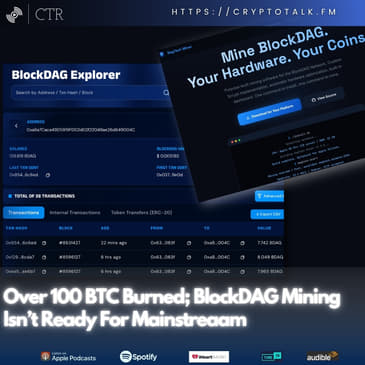
Over 100 BTC Burned; #BlockDAG Mining Isn’t Ready For Mainstream
#Crypto #Cryptocurrency #podcast #BasicCryptonomics #Bitcoin $BDAG
Website: https://CryptoTalk.FM
Facebook: @ThisIsCTR
Enjoy our programming? We offer multiple ways to support what we're doing, and appreciate the support.
Tip with NOWPayments, our partner: https://nowpayments.io/donation/leicester
Subscribe for free to receive new posts.
Share this post.
[00:00:00] Welcome to Crypto Talk Radio, the podcast for everyday investors like you. Visit us on the web at CryptoTalkRadio.net. And now, here's your host, Leicester. Thank you for that, Bailey, and welcome everybody out there on Crypto Talk Radio found at CryptoTalkRadio.net. Well, it's a hot one. Like the song says, it's hot. Very hot. The heat came out of nowhere. It's twice as hot as it was just two days ago.
[00:00:30] Hot. Not fun at all. Humidity isn't that high. It's just hot. Generally hot. Air conditioner's on. It doesn't really matter. It's hot. Generally hot. Sun's not even significantly out. It's out but not like blistering. It's just a general heat of the air feeling that is not comfortable.
[00:00:55] So, I don't even have a close parallel I can compare it to because it's not like a dry heat like Arizona. It reminds me very close when I went to, when I went to, where was I? I believe it was Oklahoma or Danbury, Connecticut. I think it was Danbury. It was that same kind of muggy feeling. Boston had a little bit of it too. A muggy feeling. That's what it is. But there's not really a lot of moisture. It's weird. It doesn't feel good.
[00:01:25] Today's episode, I've got a couple of update bits. Nothing significant. Mostly Bitcoin. But I'm going to focus more on a little bit of activity stuff that I did that I thought might have interested some folks so we can have a good chuckle.
[00:01:37] So, coinmarketcap.com. We will zoom out to the month chart starting with Bitcoin which currently is hovering just shy of the $76,000 mark as I record this with a downward trend.
[00:01:56] Of course, I said and have done for quite a few episodes now at CryptoTalk.fm that it felt like a downward pressure was still holding things back. And some of this ETF outflow and things, I don't even think that's the big reason. I have a theory. I'll get to it in a second.
[00:02:17] But somebody gave an update that said an unknown person sent 100 Bitcoin to Bitcoin's burn wallet. Bitcoin does have a burn wallet, believe it or not. So, those are destroyed. Those will never come back in circulation now. Now, unless, obviously, Satoshi shows up out of nowhere and cracks it or something. But they calculated it's about $8 million, just a little bit over, $8 million with how many that was sent over.
[00:02:47] Just burned and out of circulation. Theory, and it's all it is, is that somebody did this on accident. They didn't mean to do it. But it also could have been that somebody intentionally did it, either because they were trying to help the project. That's a laugh. Or the other theory, which I think is a stronger theory, is that they did so because they were trying to,
[00:03:14] they think, they believe that this is the end of Bitcoin as we know it as a viable, you know, project for crypto. Now, where might that thought process come from? It comes from this belief that Bitcoin is ultimately subject to the whims of big wealthy players, which I've talked about that it feels a little bit too centralized for my own taste. So, that's, that's, there's something to that.
[00:03:44] It also comes from the idea that Bitcoin, without having smart contract or other supports, is not viable for the long term. Obviously, we understand some of those things were to the detriment of crypto, which I'll talk about here a little bit later. I've, I'm fascinated though, by the amount of Bitcoin sent to that wallet, because it feels like, it feels more like either a mistake, flat out mistake, but that's kind of odd because the address is really weird.
[00:04:12] Or somebody just gave up and said, you know, screw this, bro, I'm out of this, and just sent it. But why would you do that? Why not sell them? You know, very odd, very peculiar. You know, what would be really funny is if out of the clear blue, all of a sudden Bitcoin started burning at a trickle. Just burn, burn, burn, burn, burn, burn. Not even to the level like SHIB or Luna Classic. I'm saying just a very small trickle going to the burn wallet.
[00:04:41] Kind of like a self-destruct mechanism in a form. That would be hilarious to think that such a thing could or would even exist. It's worth keeping an eye on though. Now I said, I come back to it. Let's look at Ethereum over the month chart. Ethereum currently is struggling to hold the $2,100 mark. It has a very strong downward trend. Ethereum had a couple of things that hurt its sentiment very recently. It caused a major dump within the past couple of days.
[00:05:11] Idiot Vidalic made some statements that people started connecting the dots on where there are philosophical differences with some of the people in the Ethereum foundation. Of course, Vidalic, the idiot, he is trying to keep things allegedly back within form of what made Ethereum what it is today. Decentralized, privacy, etc.
[00:05:36] Allegedly, some of these other people want to focus on the speed aspect of Ethereum. This isn't to suggest that Ethereum is slow per se, but it certainly isn't as fast as say Binance Smart Chain. Not even close. So there's a difference of strategy within the Ethereum foundation such that eight of the people from the foundation just up and quit. Idiot Vidalic said at some point he's not going to be anywhere near in charge.
[00:06:03] He's just going to be another guy, but he's still going to lend his voice because he's trying to put things back the way they used to be. And I said, you know, the easiest way to have done that, if you think about it, the one thing that destroyed Ethereum was to move away from proof of work in the first place. And he supported that transition because proof of stake is the polar opposite of the very decentralization that he's pitching. Proof of work put it in the hands of the mining community.
[00:06:32] And I told my story about the fact that at one point, mining rewards were pretty much all I was living on. So I'm very grateful for the era of proof of work. And I saw the demise of cryptocurrency overall when Ethereum, which largely leads the smart contract space, decided to go away from proof of work like some dumbasses. So the worst thing you could have done is just go back to proof of fucking work
[00:06:59] because that gets you closer to the decentralized access that you were talking about. Now, could be a bit of buyer's remorse. Could be he won't admit it because he's an idiot and too proud to admit he fucked up by supporting that move because nobody else thought it was a good move at all. The vast majority of people that had any common sense felt that proof of work was the stronger model. Obviously, there's some pros and cons to what I just said,
[00:07:29] because proof of work was more expensive on the gas side, much more expensive on the gas side, especially when things started running up and there's price spikes, like when we hit 4,000 bucks and they wanted $100 of gas. So I'm not suggesting that everything was positive in the proof of work era. I am suggesting it was superior with respect to what he is talking about. Decentralized. The best way to do that is mining and proof of work,
[00:07:59] because ultimately that's the strongest thing that you can provide for some of these is independent community contributions to it. It lives and thrives or fails by the strength of the community's contributions. And he went away from that. He voted to go away from that. And here's what the net effect of that is. So apparently, and I don't know the deep stories, I'm not inside of it,
[00:08:25] but apparently there's a lot of frustration on the Ethereum side, which is creating a compound effect to everything else that's going on, because Ethereum is, as I mentioned, center to the smart contract space. And smart contracts are starting to kind of dwindle. Pump.fund is losing its traction on the Solana side. BNB, there's memes, but they're nowhere near what it is and what it was. Everything is different now.
[00:08:55] Mostly, I argue, mostly because the one thing that Ethereum excelled at in the proof of work space is the opportunity for a truly decentralized space that rides. So, I love what I see. It makes me happy. I hope it encourages them to really think that through. And they may say, well, we can't. They could, but whether they do it or not, who goes?
[00:09:23] I don't think this Den Koon and also the garbage is going to do it. Proof of work is really the best way to save this thing. If you're not going to do that, you know, it is what it is. For the remainder of today's episode, I'm going to share some experience, experiences, around BlockDAG, not the main coin, not directly anyway, but around the mining. So, I talked about how I created my prison wallet and I'm using it.
[00:09:52] And I am the guinea pig. I am going through it as a user myself. And I'm trying to improve and enhance and tweak and get it to a point of what I wanted. And I'm going to share a snippet at the tail end. At some point of that experience, the wallet and talking it through, I actually have a demonstration, video demonstration of the wallet. I'm going to share it at the tail end at some point after the dust has settled. Not now,
[00:10:22] but I went through the mining experience. So, if you didn't know, in order to mine a Blockdag, you might have felt, well, you can't. Well, yes, you theoretically could, but it's not a, it's not a straightforward experience. It's not something the layman person is going to do because there's a lot of nuts and bolts to it. It's, it's kind of buggy. In fact, it's really buggy.
[00:10:46] But I thought I would explain the experience and then explain what I got out of it in the comments of this video. I'll share the wallet address and the link in case you want to follow and see the activity from the mining. This is GPU mining. So your graphics card of a gaming PC, my gaming PC is doing it because it's not doing anything else at the moment. So if you're curious about what that looks like, you have now information and I will go ahead and answer your questions. Up front.
[00:11:16] Is it worth the money? Absolutely not. If I say no, because the rewards are just too damn small. They're just way too small. It's ironic that the rewards are as small as they are. I get the sense that whatever they've got going on with the difficulty was purpose built for ASICS. It's a theory. I don't know for sure. However, the difficulty, and I'll explain that in a second,
[00:11:46] the difficulty on the, this GPU mining is currently sitting just shy of 16. The ASIC side is 20. So that's not significant, more difficult than a GPU. It seems rather strange. It's almost like they're purposely holding back the difficulty thresholds. And that may very well be just the lack of traffic on the chain right now. I can't say.
[00:12:14] Difficulty for those that don't know the terms in this difficulty is essentially when you're doing any kind of proof of work mining of any kind. The way it works is that your computer, your device is tasked with solving problems. Math problems. Math problems. Basically, the level of complexity of the problem correlates to difficulty. The more complex the problem, the higher the difficulty,
[00:12:43] the higher the difficulty conceptually, the higher the rewards, but also the blocks. You're looking for blocks. If you think of an actual mining, physical mining for coal or gold or something, you're looking for blocks of gold, right? In the mining space, in the digital mining space, it's similar in the sense that you are mining to try to find blocks. And you're solving these problems, hoping that you find a block.
[00:13:12] You stumble on a block. And if you stumble upon a block, you win a larger reward. That's the thought anyway. It doesn't guarantee that you will. It doesn't guarantee that you will win. It doesn't guarantee that you'll find a block. It doesn't guarantee anything. It's based on how strong your machine is. It's based on how many are mining along with you. It's based on conditions on the chain. There's a lot of different variables to it.
[00:13:40] The point is that the more miners that you have mining, they are processing the transactions that you do in a proof of work model. If you have straight proof of work, you are submitting transactions to the chain. The miners are then solving the problems that make your transaction happen. So you have to have the miners activity. I said that BlockDAG is essentially an EVM layer over top of it.
[00:14:10] That's likely in my mind where the proof of stake is coming, where you're staking your coin. This other layer that's underneath, which is dag tech seems to be where the proof of work element comes into play. The pool is dag techs. The rewards are not good. And again, it feels like it's being throttled somewhere. It feels like it's being held back. It feels like they did not want higher difficulties for whatever is the case.
[00:14:40] The A6, the X30, the X100 quoted very low rewards numbers relatively. At the time of higher prices, it might've made sense, but now 300, 600 coins, that's nothing. But based on the numbers I see, that's about realistic of what I would expect to do for the A6 side, given it's only a 20 on the difficulty. It's possible again,
[00:15:06] that it's being just artificially throttled back on the dag tech side prior to the A6 coming into play. I don't know, but I'm saying it's possible. Suffice to say that the amount of rewards granted, even with just running and letting it run is not significant. It's less than a penny. I would argue it's less than 10 cents a day, even in the optimum conditions of electricity. To me,
[00:15:35] that's not worth doing because you can buy and get much more. The whole reason miners do what they do is the potential to sell, to get money, to keep the thing going. If you're not making any money doing it, you're not going to do it. And that may be why there's so many people that are not doing it. I actually talked to somebody in core market cap who called out the low rewards and said, it's just not worth doing it. And I, I can see, and I agree with what they're talking about.
[00:16:06] In summary, if you are interested in mining, you can, I will warn you that the person who wrote this, who appears to be Dowie from Dag Tech is not a windows person. He is a Linux person and very loves, he loves his command line. So you're not comfortable to that degree. This is not for you. This is not something where you're just going to double click and run it. Like some of the other miners that are out there that they're just very seamless and easy. This is not hard,
[00:16:35] but it assumes a level of technical skill that the layman person is not going to have. But if you are interested, you can check it out. If you'd like to, you're going to want to go to miner.dagtech.network. It's a page that gives instructions. The instructions are wrong for windows and they're wrong for Mac OS. They're correct for Linux, but they're wrong for windows and they're wrong for Mac OS.
[00:17:01] The simple summary is you can download the miner software from their GitHub. When you download it, you can build it. And again, this is Linux assumed. You can build it, you can run it and it will mine. You need to give it a wallet address and that is how you're identified to the pool, but it will mine and it will give you rewards. They're all slow. And again, if you're going to do it, don't expect to be profitable. Understand it's going to be at a loss because you have electricity.
[00:17:30] You got to pay for your, your internet. You got to pay for wear and tear on your hardware. This is a losing deal. It's a loser. So if you do it, you're doing it because you want to support the chain. Okay. That's a compelling case. Not because you expect to get anything out of it. Remember, what really helps the chain is nodes. There are half the nodes are gone. And the software,
[00:17:57] which is Docker based does not appear to be straight over intuitive. And it did not let me get set up. I tried to do that when it didn't let me sit, get set up to stuff missing. So I figured I'd start with the minor and see how that worked. But at some point I wanted to test setting up a node and running it. Just their documentation sucks. They had a package and there's a different server they had. And I was going to test it, but the package is gone. They removed it according to dag tech.
[00:18:26] Sometimes they'll rotate it and they'll pull it down. So it's something I'll keep an eye on and see if it's there. You might be questioning yourself. Why are you bothering doing that when they just launched this whole turbo crap? That's a good question. Number one, I wanted to go through the experience. I wanted to see what it was like to get set up. And what I saw told me the mainstream person is not going to do this. Two, it's buggy. As I said, it's, it's horrifically buggy. As I,
[00:18:55] as I record this roughly, let's see, 24, 28. So five, four, so four, 25% ish. Yeah. About 25% of what gets submitted through the mining process. So these shares and blocks that I refer to 25% of them fail for no logical reason. They just fail. This is unstable because I can mine on any other minor out there.
[00:19:25] And I've mined on a lot of them. I told you about the mining rewards and I don't have anywhere near this failure rate. This tells me it's simply not ready for prime time. And because it's not ready for prime time, I couldn't advocate it for anybody. And the fact that they're relying too much on Linux and command line, they got a lot of work to do. Consider you're not mining on block bag itself.
[00:19:47] You're mining on dag tech because dag tech is running the node and you're mining into their node as a pool. You're supposed to be able to mine your own pool, but you can't yet because again, the Docker software to set your own node up isn't working. The package isn't out there. If I see that change, I'll consider it. But I wanted to go through the pain. I wanted to understand the process. I wanted to make sure I wasn't speaking out of turn with it. And I didn't want to be unfair. I want to be clear.
[00:20:17] Is there something here? What's the instructions? Here's what I can tell you. There's certainly some blockchain stuff here. There's some technology here, but it's rudimentary. It's outlawed. It's the T-moo of. It's not advanced by any means, but there is something there. There's certainly something there on the block dag side too, because they have a whole separate server with the Docker package.
[00:20:45] You don't have a Docker package if you didn't spend time doing it. That said, a lot of what I see with the dag tech side was built with AI. And I talked about how AI reliance seemed to be infecting a lot of this stuff. So it may be that what I'm seeing is too heavy reliance on AI, where they don't have the skills to do it themselves. And that's contributing to some of the garbage. So how does turbo come into play? Allegedly, turbo is to be a toy,
[00:21:15] a token rather on the block dag blockchain. Allegedly, turbo is designed to do things like rewards, casino payouts, et cetera, as opposed to the main B dag coin. Now, the only reason that would make any sense is with a significantly lower supply of the B dag coin. In today's AMA, they only burned 250 million, not the 1 billion they said they were going to do.
[00:21:45] So if they're not going to drop the supply to a significant degree, it's not going to go anywhere. Turbo by itself is not going to do it either. It's just another way to generate more money in my lens. And the mining and everything feels rudimentary and half baked and not ready for prime time. I don't know why that is exactly other than heavy reliance on AI and a lack of knowledge and skills to pull it off themselves. That's what I see. Remember, we haven't seen Jeremy since.
[00:22:16] So I'm going to mine every now and then. I'm not going to let it run 24 seven because obviously it's a losing proposition, but I want mine every now and then. Hopefully they get the windows side fixed. Hopefully they get the Docker package back up. Then I can set up my own pool, which lets me set up my own node. Then I can mine against that. And then I can test that experience and provide feedback.
[00:22:42] But I do it because I need see anybody that's doing any op-ed. It's doing any coverage. The difference between me and some of these others, like the consensus, the consensus, they went through some of this. They set up certain of the mining and nodes, and they went through some of this. So they had some exposure on that side. The flaw of those people, unfortunately, is arrogance.
[00:23:13] Because the team trusted them and gave them information, which those people used against the team, thus causing the team to overreact, thus causing what I argue was a, an accelerated loss of money because of ego. Ego's got in the way. My exposure doesn't do anything negative to you. It informs you.
[00:23:39] It goes through the exercise using my talent of technology, because I do it for a living, to share information at a lower level, not to sell you on doing it. I provide basic information, and I tell you it looks like a shit show. And I'm trying to help explain a lot of the problems that I see. I don't see technical skill, like significant technical skill here. I don't see it. I see very basic,
[00:24:09] if I had to put it on a scale of one to 10, the things I see here are about a four or five, maybe six. We're not talking highly skilled, highly technical things here. And some of this is built in Visual C+, C++. I don't, I've never written a C++ application, but even I can look at what's there and fully understand what it's doing because it's rudimentary. It's just basic rudimentary.
[00:24:39] If for what it's worth, and it's fine if you don't believe me, but for what it's worth, I'm going to maintain, you're dealing with a set of people on two sides that simply, they don't know what they're doing with this. And I don't fully understand, frankly, why or how with so many people before the cuts, none of this got done. I struggle that because if I see what I see here,
[00:25:09] they should have had this done a year and a half ago. Easy. So I don't know where things went wrong other than two lofty goals, maybe. But what I see explains the fickleness of the staking, the fickleness of wallet transfers and wallet displays and everything else. And the turbo again feels like just an abstraction, not a distraction, an abstraction.
[00:25:35] Abstracting the main coin from these non-relevant use cases. That you wouldn't gamble with the BDAG coin. You would gamble with something else that relies on the BDAG coin. A case can be made, but it only makes sense with a much more constrained supply. And you still have to solve the exchange issue. And you still have to solve this minor issue. They got issues. The stable coin,
[00:26:03] somebody asked about this, uh, tether, this, uh, peg to tether. All I have is a theory because they're very, they're very tricky about how they word some of this stuff. All I have is a theory. Way back at the end of last year, I was talking about the different options that the project offered. They offered four choices. They offered a vote. There was a voting page.
[00:26:33] When they were taught, this is after Turner admitted on record that they oversold and they asked the quote community to vote on the way forward. One of the options was a stable coin. And I said at the time, I thought that was the best option. Now the consensus who happened to be the only people the team was listening to, the team embraced those two as speaking on behalf of the community.
[00:27:02] One of the consensus said, and I quote, I know that not everybody was happy with the decision, but we took a vote and the consensus voted for this option, which was the compression. Now I argue that those consensus members didn't understand what they were agreeing to. What they were agreeing to is the loss of your money.
[00:27:27] They just didn't understand it because their ego got in the way and they didn't realize you're agreeing to let them take money from people. That's what you're agreeing to. And they sold you on it because unfortunately two of them are very good salesmen. And unfortunately, when the consensus attacked, my voice got suppressed. No problem. I had to back off because I had to let you learn. A kid has to burn their finger to know that fire hurts.
[00:27:57] When you support people that don't know what they're doing, this is the net effect. You get harmed. You get burned. When I warned multiple times that I don't think that's the right answer. And you're going to need a stable coin anyway. Anytime it's a blockchain, you have to have a stable coin because if you don't have a stable coin, you can't create liquidity pairs. Without liquidity pairs, you can't do a DEX. Like these are fundamental things that certain of these people didn't understand.
[00:28:23] The project now surfacing this stable coin allegedly to me is in response to Zach XBT's messaging. Not necessarily that it's the right thing or that it's true or that it's legitimate, but simply because of a response to say, look, we have liquidity. Here's $25 million sitting in Tron wallets. Now, what was the argument? The argument was that some of this was interplayed between Spartans. Okay.
[00:28:53] And, but there's still $25 million there. You can validate it is. So what's, what's really the down that it's commingled funds that applies to the regulated space, not the unregulated space in the regulated space. Certainly you would see a red flag in the unregulated space. It has one bottom line test. If there's 25 million today, will there be 25 million always? However, it happens because it could go down, but then back up again. If it does,
[00:29:23] they've not broken any promises and they've not broken any law specificity. Specifically, is it unethical? Absolutely. But the point is, if they tell you there's 25 million and they say, go look and watch it. What are you squawking at then? If they use it and there's always 25 million put back in there, what are you squawking about them? There's still a risk because the source of the 25 might come from a sketchy place.
[00:29:50] And if it comes from a sketchy place and then those happen to get blocked, there was a situation today about a stable coin issue and they froze 13 million of funds. You could have funds that get frozen due to something completely unrelated to what you're doing, but because they were sent to you from a wallet that was compromised, say, or involved in criminal activities, they are subject to be frozen regardless of where they ended up. These are real risks. So I'm not downplaying the risk.
[00:30:17] I'm saying that what they're trying to state as the risk, how's it a risk? If really, it's just a measure test. If 25 million is made available, is there always 25 million available? And is it always available to the block deck project? It's simple. If it's not, now you have a case because a developer makes money available, makes it not available. That's a rug pull, right? Then it's easy. But I said,
[00:30:47] you won't beat him because he's smarter than you. Not you, you. I'm talking the consensus. He's smarter than you. So I said, I said that months ago, he's smarter than you. It's obvious he's smarter than you because one of you is locked up and you said he should be locked up and he didn't get locked up. You did. So how can he not be smarter than you? Right? In any event, I, I think this is my theory.
[00:31:16] I think that this whole Steve a coin. I, my theory is they're pegging not one to one, but some alternate ratio of some kind. Where's my theory coming from? It reminds me somewhat of the way that liberal was going to do wrapped liberal, which became liberal, where it wasn't a one to one. They had a ratio.
[00:31:42] It was like 20 to one or something because what they were trying to do is they were trying to control supply because liberal was printing out of control with a constrained supply liberal and it didn't work, but that's what they were trying to do. My theory, only a theory is you have something similar here where they're pegging at a different ratio than a one to one. That's not really a one to one. That ratio could be literally anything.
[00:32:12] If we're going just off of the 25 million in liquidity, there's no way that they could say, okay, 25 million BDAG of the stable coin peg to this 25 million in Tron. I just don't, I don't see that they would do that. Maybe they will, but I don't see that they would. To me, it feels like more of a better ratio type deal, maybe a four to one.
[00:32:40] So you'd have a hundred million BDAG peg to this 25 or something of that nature. Because the only reason logically to do something like this is to be able to work with that liquidity and be able to bridge eventually, but also create pairs and do deck swaps and things. But I just, my gut tells me there's no way they're going to do a one to one.
[00:33:09] If they do a one to one, let's say they do a one to one and they peg it to these, these liquidity pools. So they say that means those have to always be available by that's a regulatory thing. A lot of these, a lot of these regulations, they require, if you're going to do that, you have to have the reserves and proof of reserves. And the exchanges would love to see that you do have proof of reserves, which are stable.
[00:33:38] If let's say the stable gets on the exchanges, I don't think it will, but let's say it does. I don't see how the consensus can really have a case because then, I mean, all, all bets are off because you now can do anything. You can do anything on the decent side. And it defrays the narrative of people being quote trapped outside of the pre-sale cadence. cadence. But the problem, as I said,
[00:34:06] is you can trade it just and get your money back. And if you choose not to, that's kind of a personal thing. So I, I suspect again, the ratio is not one to one. It's my theory. If they do launch something, I think the ratio is not one to one. I saw the email, what it said. It doesn't specifically say from what I can tell that it's a one to one. So I don't think it will be. And if they're giving away $10,000 worth of it,
[00:34:36] I, I, to me, that's going to simply be some sort of a pegging on the BDAG side. That's, that's my theory. And I don't know what the pegging is. I have no idea. Pegging of the BDAG stable coin. I don't know what that is. I suspect it's a lower ratio of some kind, but I don't know for sure. In summary, I watch because I must do. This is the only way I can provide the feedback.
[00:35:04] My impassioned plea to you is I'm not telling you to take any out. I'm telling you to reflect, reflect on what happened. If you were in the last part of last year, if you happen to be one of the consensus and you listen to people who steered you down the wrong path. And I include Anthony Turner in that, by the way, are you any better off? The answer is no, but,
[00:35:31] but the current leadership did something Turner could not do, which is enable you to trade on exchanges. Are they the best exchanges? Absolutely not. But you were able to trade on exchanges. Some people chose not to. When I say trade, I'm not talking about, but going stuck in the water. I'm talking, take a little bit more money, put it in there, let it 10 X, get it out, get your money back. You're done. That's what I'm talking about. There were people that did that. The current did that. Turner did not.
[00:36:02] Period. So reflect. You were misled at multiple fronts. You're misled. You continue to be misled now, certainly, but you were misled before. Nothing's changed in that regard. My participation in things like this is so I can do a service as somebody who's op-ed. So I can provide you information that you may not be aware of, but also to be objective.
[00:36:29] I'm not one like certain people who will make a definitive statement of fact about scam. Because what I see here, at least is 10 times better than Cytochain for what that's worth. Well, how can that be? How could it be that Cytochain, which whose leaders, by the way, that caught up on the lamb, some of them arrested. This, there's more here than that.
[00:36:58] I still just see desperation. I see they're trying to buy time. I see they're doing, throw shit against the wall, hoping it sticks. There's a shit ton of that. I see instability. I see rookie coding. I see AI reliance. Like I don't, I just don't see blatant scam. I see incompetence. I see people that don't know what they're doing. I see people that are struggling.
[00:37:28] I actually see struggling in some of this stuff. And then the time zone is a whole different problem. So I'm going to continue watching this and sharing what I can share again, because I want to be objective period. Period. You'll never hear me say a statement of definitive fact, other than what you have right now. It's not ready for primetime. And if the CEO hears it, and I know he will, I just said that what you have right now is not ready for primetime. Might think it is. It's not,
[00:37:57] it's not going to hold up. If you put it under stress, it's not going to hold up. Not what you have. And you need, there's some serious work needed here. Whoever's convinced you to go with a skeleton crew and AI reliance is going to be the death of you. And I don't mean literally, I mean the project. You can choose the disregard if you want. That's cool. I'm calling it like I see it,
[00:38:22] because I see it's very rudimentary and in dire need of some work. And I don't just mean launching more coins. I'm talking about the technical stuff behind the scenes desperately needs work.